
Học Tiếng Hàn Nhưng Không Có Người Luyện Nói? Luyện Nghe, Nói Với AI Cùng Dami S
Studying Korean but have no one to practice speaking with? Here's how you can improve your communication reflexes
You've been learning Korean for a while, but when you meet a Korean person, you don't know what to say? You can read and understand Korean sentences, you've learned a lot of vocabulary and grammar, but when it comes to real communication, you run into problems like: Fear of mispronouncing. Fear of making grammar mistakes. Knowing the words but not being able to put them into sentences. Hearing Koreans speak but reacting too slowly. Knowing in your head what you want to say but not being able to express it in Korean. Not having a native speaker to practice speaking with regularly. Wanting to practice speaking but not knowing who to turn to for corrections. Having a practice partner but not always being able to coordinate schedules. This is one of the reasons many people study Korean for a long time but their communication reflexes remain weak.
Why do you study so much but still can't speak Korean?
Learning Korean isn't just about memorizing vocabulary and grammar. To communicate well, you need to practice a whole chain of skills: Listen → understand → think → express → speak → receive feedback → correct → speak again. If you only study through books, watch videos, or memorize vocabulary, you may understand quite a lot of Korean but lack the opportunity to practice the step of "saying it yourself." In particular, when you have no one to practice with, you can easily develop the mindset: "I'm afraid of saying it wrong, so I just won't speak." The less you speak, the slower your reflexes become. The more afraid of mistakes you are, the fewer chances you have to correct them. And in the end, you may fall into the situation of "studying a lot of Korean but not being able to use it in communication."
Dami Study – Practice speaking Korean with AI anytime, anywhere
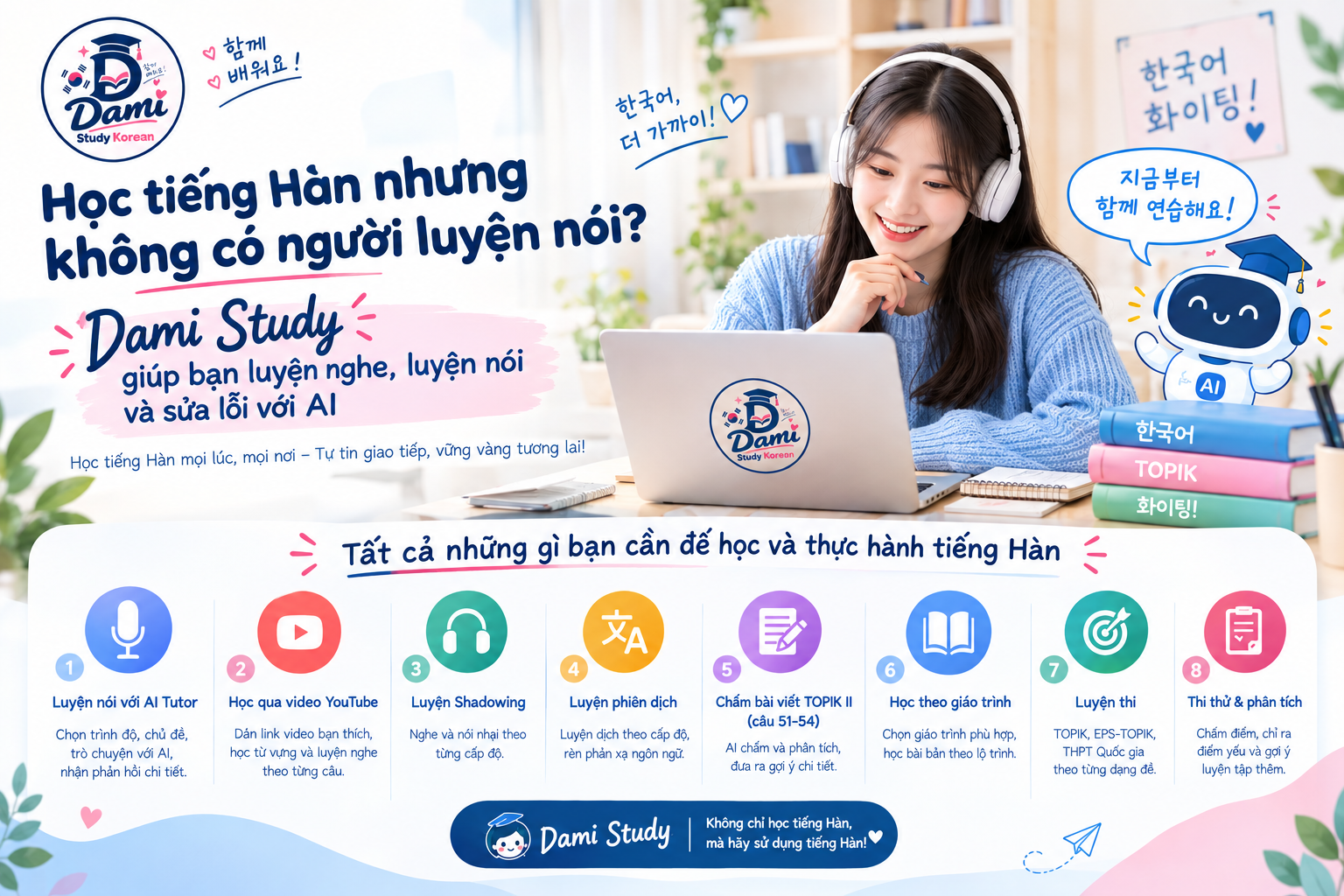
Dami Study was built with the goal of giving learners an additional environment to practice listening and speaking Korean regularly, even when you don't have a Korean person by your side. With AI Korean Tutor, you can practice conversations according to the level and topic you choose. You don't need to wait until you have a class. You don't need to find a Korean friend to practice speaking with every day. You can open Dami Study and start practicing right away whenever you have free time.
How can you practice speaking with AI?
After entering the AI speaking practice area, you can choose the level that matches your ability: Beginner Intermediate Advanced Choosing your level helps the conversation better match your Korean proficiency.
Step 2: Choose a communication topic
Next, choose the topic you want to practice. For example: Introducing yourself Work Daily life Shopping Travel Restaurants School Interviews Workplace communication Real-life communication situations Practicing by topic helps you not only learn individual vocabulary but also learn how to use Korean in a specific situation.
Step 3: Answer the AI's questions with your voice
The AI will ask questions or present communication situations. Instead of just reading sample answers, say your answer yourself in Korean. You can say everything you know. Don't worry too much if your sentences aren't perfect. The first goal is to dare to speak and express your thoughts in Korean.
Step 4: The AI analyzes and responds
After you answer, the AI will analyze your speech and give feedback. You may receive suggestions related to: Ways of expressing yourself. Grammar. Vocabulary. Sentence structure. How to answer more naturally. Points that need improvement in your answer. The important thing is that you don't just know "I'm wrong," but also have the chance to understand "how I should say it."
Step 5: The AI continues suggesting to take the conversation deeper
After your first answer, the AI can continue asking new questions or making new suggestions. This helps you not just answer a single sentence but continue developing the conversation. For example: The AI asks you about your work. You answer about your job. Then the AI can continue asking about: Your daily work. What you like or dislike about your job. Difficulties at work. Future career plans. Thanks to this, you get to practice maintaining a conversation in Korean, instead of just memorizing ready-made answers.
Different levels – different ways of conversing
Someone new to learning Korean shouldn't be asked to say sentences that are too long and complex. So when using AI Tutor, you can choose the appropriate level.
Beginner
The questions and expressions will be simpler. You can practice short sentences and familiar topics such as: Introducing yourself. Family. Hobbies. Weather. Food and drinks. Daily work. The goal is to help you start speaking Korean without too much pressure.
Intermediate
You can start practicing longer sentences and expressing more ideas. For example, instead of just answering with a short sentence, you'll be encouraged to explain: Why do you like it? What did you experience? What do you think? What will you do in the future? This helps develop your ability to express ideas in Korean.
Advanced
At a higher level, you can practice conversations with richer content. You may need to: Explain your point of view. Give reasons. Compare options. Present opinions. Argue back. Recount an experience. Discuss more complex topics. The goal is to take learners from "being able to say Korean sentences" to being able to "maintain and develop a conversation in Korean."
Don't wait until you speak correctly to start speaking
One of the most common mistakes when learning a foreign language is: Waiting until you're good before starting to communicate. But in reality, communicating is itself part of the learning process. There will be times when you say something wrong. There will be times when you use the wrong word. There will be times when you get the grammar wrong. There will be times when you don't know how to express yourself. That's completely normal. What matters is having an environment to try → get feedback → correct → speak again. Dami Study wants to help learners build that habit.
Practice Korean anytime, anywhere
You don't need a Korean friend by your side 24/7 to practice speaking. You can make use of short pockets of time during the day to practice: 10 minutes in the morning → practice one topic. 15 minutes during break → practice one conversation. 20 minutes in the evening → practice speaking and correcting mistakes. What matters isn't how many hours you study each day. What matters is that you actually use Korean regularly.
Start practicing speaking Korean with Dami Study
If you're learning Korean but feel: "I can study but I can't speak." "I know the vocabulary but I can't react." "I'm afraid of making mistakes when communicating with Koreans." "I don't have anyone to practice speaking with regularly." Try turning your Korean study time into communication practice time. Visit Dami Study, choose AI Korean Tutor, select the appropriate level and topic, then start speaking. Don't wait until your Korean is perfect to communicate. Communicate so that your Korean gets better and better. Dami Study – Learn Korean. Practice. Speak. Improve.
🎁 Invest 3 months in learning Korean – for just over 200,000 VND/month
If you want to seriously improve your Korean, try Dami Study's 3-month Premium package at 799,000 VND. On average, that's only about 266,000 VND/month – roughly the price of 2 milk teas. Instead of spending money only on short-term expenses, you can invest a small amount in learning to gain more time for listening practice, speaking practice, reflex practice, exam practice, and daily Korean practice. With Dami Study, you can learn and practice anytime, anywhere, on your own schedule. 🚀 Ready to start? Sign up for 3-month Premium – 799,000 VND